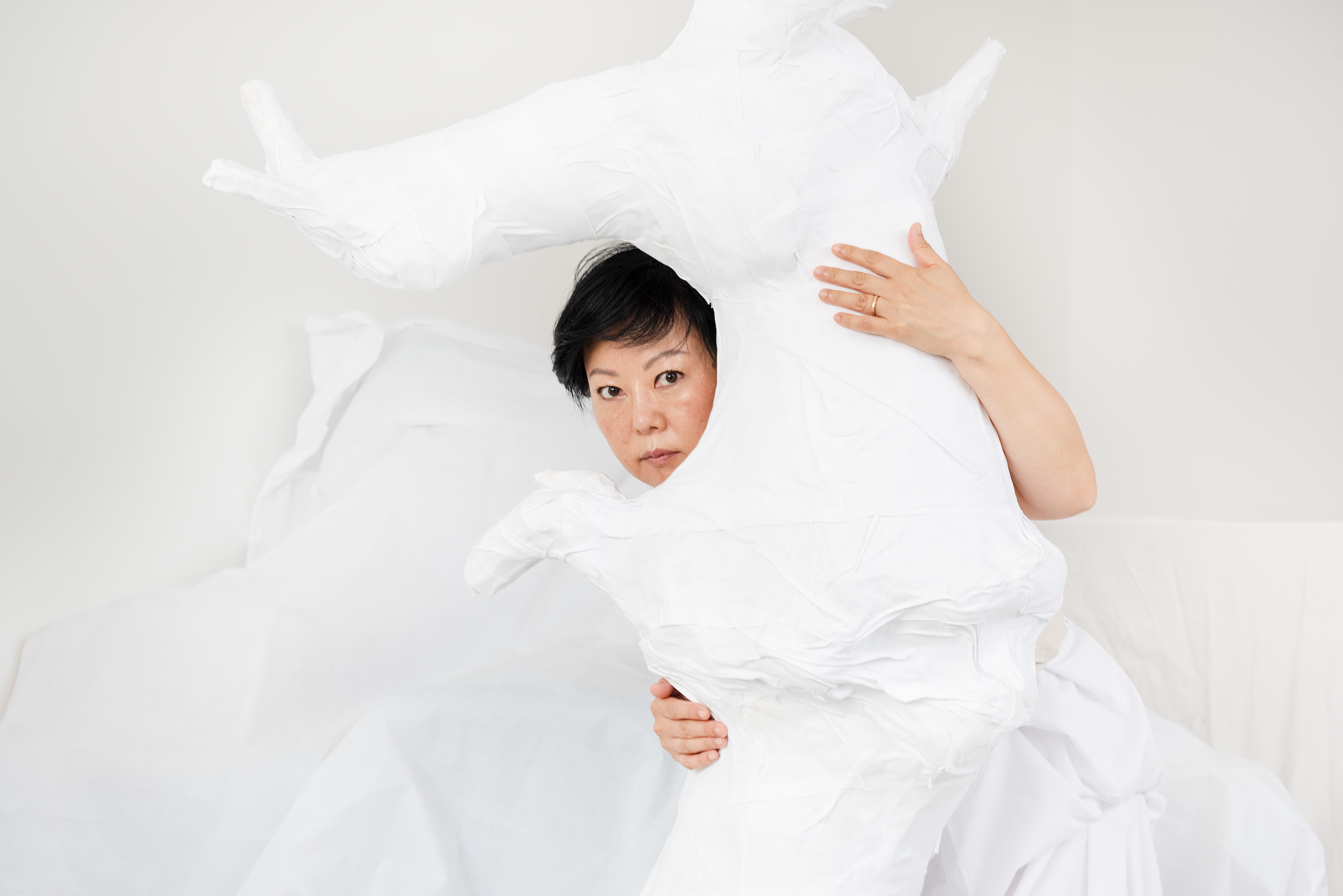
Eugenie Lee is a CripQueer, autistic, 1.5th-generation Korean-Australian interdisciplinary artist living and working on Wangal Land in Sydney. Her practice explores new ways of telling stories about experiences that are often stigmatised, including chronic pain, medical misogyny, hidden disability, and diaspora. Drawing from her own lived experience, she works across participatory performance, installation, sculpture, painting, and creative technologies to create experimental works that make complex, embodied experiences visible.
Collaboration is central to her practice. Lee works closely with pain scientists, neuroscientists, humanities researchers, technologists, and communities with lived experience. Through these partnerships, she explores how subjective experiences, especially those related to health and wellbeing, can be communicated in different ways.
Notable curatorial exhibitions include Wellbeing Garden for Access Intimacy at AGNSW, Psyche at Science Gallery Bengaluru, The Big Anxiety Festival at UNSW, MOD.IFY at MoD, and The Patient at UNSW.
Eugenie has received numerous awards, including Creative Australia, Create NSW, and Synapse from the Australian Network for Art and Technology (ANAT). She is an access consultant, advocating for disability and CaLD representation in the arts, and a member of the Global Alliance of Partners for Pain Advocacy Task Force (GAPPA) for the International Association for the Study of Pain (IASP). She holds a Bachelor of Visual Arts (First Class Honours) from Sydney College of the Arts.